
This site uses non-intrusive cookies to enable us to provide a better user experience for our visitors. No personal information is collected or stored from these cookies. The Society's policy is fully explained here. By continuing to use this site you are agreeing to the use of cookies.
Chief Mechanical Engineer
In this country, the turning of the locomotive at the end of the run is one of the duties of the Locomotive crew, and it may be a matter of surprise that this operation even with the largest locomotives is within the capabilities of two men.
The turning of an engine is performed on what is known as a turntable, the majority of which so far as the LMS Railway Company is concerned, are hand operated. The lines of the turntable have, of course, to be set opposite the running lines on which the locomotive stands and the table is then locked into position by means of levers. The engine is then run on to the table and is stopped in such a position as to give the best balance after which the brakes are applied to prevent any movement of the engine during the turning operation.
When the engine is thus set, the locking levers are disengaged and the table is then free to be turned by the driver and fireman who either push by means of bars which are hinged at each end of the turntable and extended when in use, or they turn by means of a hand winch on an operating platform on one end of the table.
The turning is only possible because of the balancing of the load on a centre bearing of a very small diameter by which means the friction is reduced to a low value and because the effort which the men apply to the extended push bars is at a relatively large distance from the centre. It is, however, harder work to turn the engine if the table is almost due for repairs, in which case the bearing surface of the centre pivot will have spread by wear over a large diameter with a corresponding increase in friction. For the purpose of reducing the effort required, geared hand winches were provided on all the later tables and as a further development, these were fitted with high and low gears, either of which could be used as required.
In the early part of 1935, the 70-ft. diameter turntable at Euston was fitted with a vacuum engine for power turning and as the results were so promising, arrangements were made for fitting similar equipment to a considerable number of existing turntables, and on new turntables about to be installed, which means that practically all the turning of the heavier engines on the system will be done in future on power-operated turntables.
The vacuum engine, as the name implies, is an engine in which vacuum or suction is employed as a driving force. The operation of the engine is very similar to the toy steam engine in which the whole cylinder oscillates in order to admit steam to the correct end of the cylinder. In this case, however, instead of admitting steam, air is drawn out from one side of the piston which causes atmospheric pressure to do work on the other side.
The vacuum engine shown in the illustration is of the twin cylinder double acting oscillating type, and this was considered the simplest form of engine for the purpose required. No valve gear is necessary as the distribution of the air to the engine cylinders is controlled by the oscillation of the cylinders on their pivots.
The reversing operation is carried out by the movement of the control lever A, which changes over the air and vacuum ports. The cylinders are 4½ in. bore and 6 in. stroke and where necessary aluminium alloy is used to reduce the weight of the moving parts, in addition to which ball and roller bearings are used wherever possible.
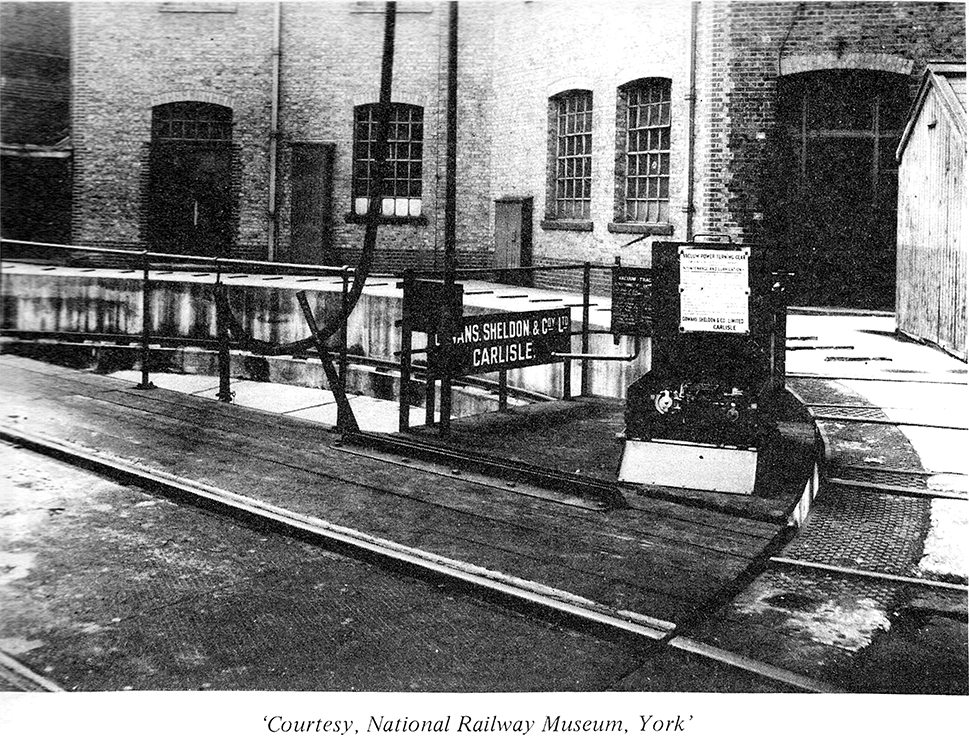
The photograph of the Euston turntable shows the application of a vacuum engine to the balanced type of turntable, that is, a table on which the locomotive has to be set with its centre of gravity as nearly as possible over the centre pivot so that the pathway wheels which run on the circular track in the pit are almost entirely relieved of load, and thus the only resistance to turning is the friction of the centre pivot.
It will be appreciated that in the case of balanced turntables where clearance is always left between the pathway wheels and the pathway rail, it would be impossible to couple the drive of a vacuum engine to one of these wheels so that an independent wheel and drive are incorporated in a self-contained tractor hinged to the main girders at one end of the turntable. The weight of this tractor which contains the vacuum engine, emergency hand-turning gear and the driving wheel is sufficient to give the necessary friction between the driving wheel and rail to move the table.
When applied to balanced tables, the engine drives through double reduction gear to a driving wheel on the circular pathway rail of the turntable. There is a hand-turning gear for operating the table when the table has to be turned light, or in other circumstances when vacuum is not available for operating the engine.
The majority of the turntables on the LMS system are of the balanced type, but there are, however, a number of tables in commission or in the course of construction of the non-balanced type, in which case the girders are so designed to distribute the weight of the locomotive between the pathway wheels and the centre pivot.
As there is never any clearance between the pathway wheels and rail with this design of table, it is possible to apply the vacuum engine drive direct to one of these wheels and the photograph taken at the Camden Shed shows a table of this type which has been recently installed.
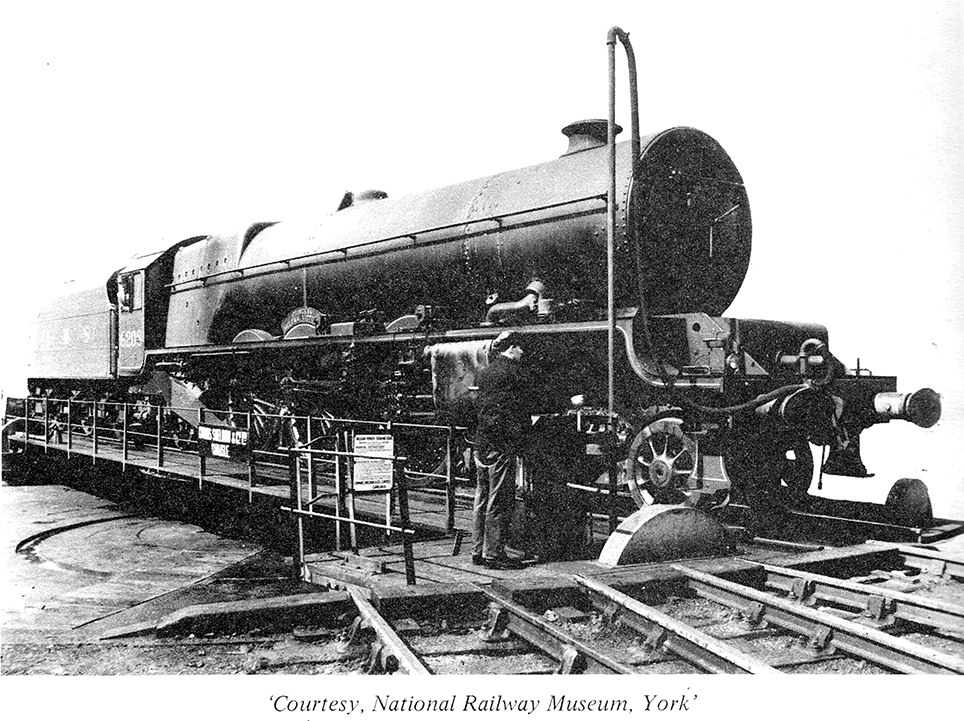
As previously mentioned the operation of the turntable is carried out by the engine crew and when a vacuum engine is fitted, is performed as follows: The fireman couples the long flexible hose to the locomotive vacuum brake hosepipe after which the turntable locking bolts are withdrawn and the vacuum engine set into motion by moving the control lever in a clockwise or anti-clockwise direction according to which way it is desired that the table shall be turned. The driver remains on the footplate of the locomotive to operate the vacuum ejector. When the locomotive has been turned sufficiently, the table is brought to rest by moving the vacuum engine control lever to the reverse position and with a little experience it is easy to stop in the correct position for inserting the table locking bolts in preparation for running off the locomotive.
The last illustration shows the fireman controlling a vacuum-operated turntable on which the largest locomotives can be turned through 180 degrees in 1½ minutes with no effort on the part of the engine crew.
Site contents Copyright © LMS Society, 2026

October 6th, 2026
Site contents Copyright © LMS Society, 2026