This site uses non-intrusive cookies to enable us to provide a better user experience for our visitors. No personal information is collected or stored from these cookies. The Society's policy is fully explained here. By continuing to use this site you are agreeing to the use of cookies.
[as described in the May 1937 edition of the “in-house” LMS Magazine.]
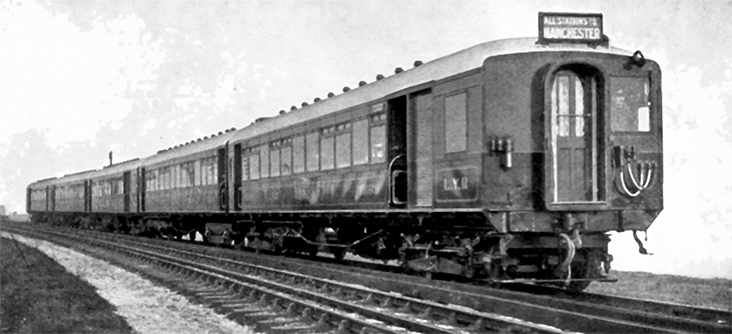
All-metal stock constructed for the opening of the Manchester-Bury electrification
IN conversations and discussions about railway electrification it is often assumed that electric traction is still somewhat of a novelty and it will be interesting to get a rough idea of what has been done.
The following table gives the figures for a number of countries up to the latter half of 1936. As electrification is growing rapidly in several of these countries the figures are naturally approximate only.
| Electrification of Steam Railways | ||||||
|---|---|---|---|---|---|---|
| Great Britain | Italy | U.S.A. | Switzerland | Sweden | France | |
| Route miles electrified | 667 | 3,185 | 2,230 | 1,870 | 1,770 | 1,752 |
| Under conversion | 85 | 375 | - | 20 | 400 | 410 |
| Total railway mileage | 20,350 | 11,400 | 245,750 | 3,645 | 10,460 | 40,350 |
| Percentage electrified | 3.28% | 31.8% | 0·91% | 51.3% | 16·9% | 4·35% |
When making comparisons it must not be overlooked that in some countries the reasons leading to railway electrification have not been primarily the undoubted amenities and technical advantages of electric traction. For instance, Italy and Switzerland have carried out extensive electrification in order to use their large hydroelectric power resources instead of importing coal for steam locomotives
In other parts of the world conditions which played very influential parts in deciding upon a changeover are :
As to how far these conditions apply in this country is a matter of opinion, but the electrification which has so far taken place has been very largely of a suburban character where a frequent service with heavy peak load periods has been necessary and electrification has had no chance to show what it can do under what may be called normal conditions.
It has to be recollected that the relationship of the State to the British railways is very different from that in any other country and the L M S position was tersely explained by the chairman in 1935 in the following statement to the shareholders:
"I must again refer to electric traction in so far as it affects us. We have 117 miles of road, or 282 miles of track, which has been constructed or adapted to electric traction during the past 32 years, at a cost, with equipment, of £11,000,000.
"Close consideration has recently been given to further suburban electrification and the general question of main line electrification. Although our enquiries are not complete, there does not appear to be any likelihood of any further large scale outlay in the immediate future.
"We have a statutory obligation to show annually to the Railway Rates Tribunal, that our affairs have been conducted with efficiency and economy, quite apart from the Board's obligation to you in this respect, and any new outlay for electrification or anything else must comply with that test. If any new work is unlikely in due course to pay its way, clearly the burden will fall on railway users generally, or the proprietors or employees, or partly one or another. Such outlay differs from the competitive expenditure on public roads for motor traction, which causes a charge on the rates, whether the expenditure is commercially justified or not.
"Those who talk glibly on the subject without knowledge of the facts may not bother much about this aspect, but we have to do so. The merits and amenities of electricity have to be weighed against the merits of other forms of tractive power, with due regard to the risk involved in new outlay on fixed plant in the present still indefinite position of the finance of the public roads."
The history of railway electrification in Great Britain commences with the construction of the tube railways in London, beginning with the City and South London Line in 1890. Electrification offers the only practical means of operating intensive tube services so in the case of these lines the problem is not quite the same as in the case of ordinary steam railways.
In 1904 the Lancashire & Yorkshire Railway Company ran the first trial trains on the Liverpool-Southport section of their line. The innovation was successful and led to a reduction in the timing of stopping trams between Liverpool and Southport, notwithstanding the fact that additional stations had been built. The 600-volt direct current conductor-rail system chosen, was a natural development of electric tramway practice.
A few years later a number of engineers were favouring the single-phase system of electrification. This had been developed extensively in Switzerland and America, and in 1908, following a visit of some Midland Railway engineers to the latter country, a short section of line between Lancaster and Morecambe was equipped for single-phase operation at 6,600 volts, in order to obtain experience of this system of working.
This was followed shortly by the electrification of a section of the London Brighton and South Coast Railway on the same system. The first of these installations is still working but the second, after some fifteen years of service, was converted to direct current third rail in order to unify the system on the Southern Railway, part of which it had then become.
Shortly before the War it was decided to electrify the suburban services on the London and North Western and the London and South Western Railways' London suburban lines. Both these schemes were undertaken on the direct current conductor-rail system, largely because of the better results which were being obtained with the direct current traction motor. At the same time it was recognised that the advantage of the higher voltage of the single-phase system in reducing the number of substations had a considerable influence on the cost of any scheme and with the object of obtaining both these advantages the Lancashire and Yorkshire Railway Company in 1913, carried out an experimental electrification from Bury to Holcombe Brook, employing an overhead contact wire and direct current at 3,500 volts. The results were successful except that difficulties were experienced in securing adequate clearances for the contact wire equipment and later, when an extension to Manchester was carried out, the line was converted to the then recently developed, Aspinall side contact conductor rail at 1,200 volts, direct current.
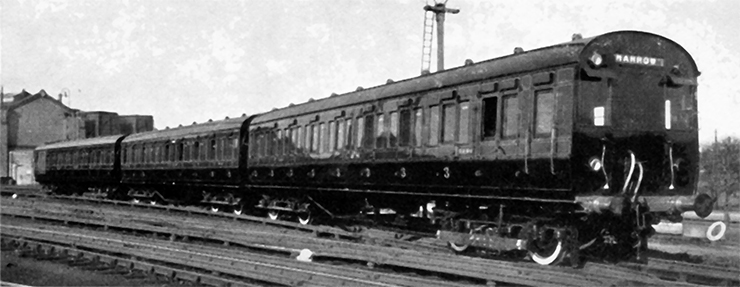
Compartment stock on Euston-Watford line
Having regard to the considerable length of line now electrified in Italy and elsewhere on the 3,000 volt direct current overhead system, there can be no doubt that the Bury-Holcombe Brook electrification was a far-seeing experiment on the right lines, but so far as this country is concerned, recent technical progress has tended to favour the direct-current systems at voltages lower than 3,000.
With the possible exception of underground lines, differences of opinion appear always to have existed among engineers and others as to the most suitable system of electrification for any particular circumstance. This is perhaps only natural when it is remembered how in the infancy of electric traction the new power offered so many different methods of utilisation; in some countries as many as five different systems have been put into operation. In this country the Government, foreseeing another "Battle of the Gauges" in the railway world, appointed a committee to consider the matter so that a decision on the question of standards could be reached before the situation became too complicated and commitments too heavy. The committee reported to the Minister of Transport in 1927 recommending that future electrification in this country should be on the direct current system with either overhead collection at 1,500 volts or third rail collection at 750 volts. These recommendations are now incorporated in the Minister of Transport's Order, 1932.
Since this date the Southern Railway have converted the whole of their electrified lines to the third-rail system and considerable extensions have taken place reaching as far as Brighton and Worthing in January 1933, Eastbourne and Hastings in July 1935, while further extensions are in hand. In 1932 the M S J & A Railway suburban passenger service owned jointly by the L M Sand L N E Railways was electrified on the 1,500 volt direct current overhead system. The overhead system was chosen largely on account of the importance of this line as a connecting link in the event of parts of the main line being electrified.
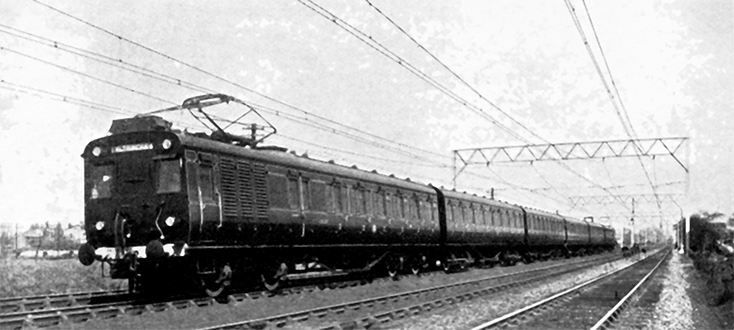
Six-car train on Manchester-Altrincham line
At the moment of writing, on the L M S, certain lines in the Wirral Peninsula are being electrified and on the L N E suburban lines around London and Newcastle-on-Tyne and also the main line between Manchester and Sheffield are under conversion. Where these new electrifications form extensions of existing electrified lines, the same system is, of course, used, but in other cases the tendency is to employ a 1,500 volt overhead system largely with a view to facilitating more extensive undertakings in the future.
This article gives a rather brief outline of the position of electric traction in this country at the present time. In order to give a better idea of the actual plant and equipment used in electrification it is proposed to publish in later numbers of the magazine a series of articles describing the L M S electrified lines in the London area.
We are indebted to our Electrical Engineer's Department for the preparation of these articles under the direction of the Electrical Engineer, Mr. C. E. Fairburn, M.A., who has been engaged extensively on railway electrification in all parts of the world.
Site contents Copyright © LMS Society, 2026
June 11th, 2026
Site contents Copyright © LMS Society, 2026