This site uses non-intrusive cookies to enable us to provide a better user experience for our visitors. No personal information is collected or stored from these cookies. The Society's policy is fully explained here. By continuing to use this site you are agreeing to the use of cookies.
[as described in the March 1934 edition of the “in-house” LMS Magazine.]
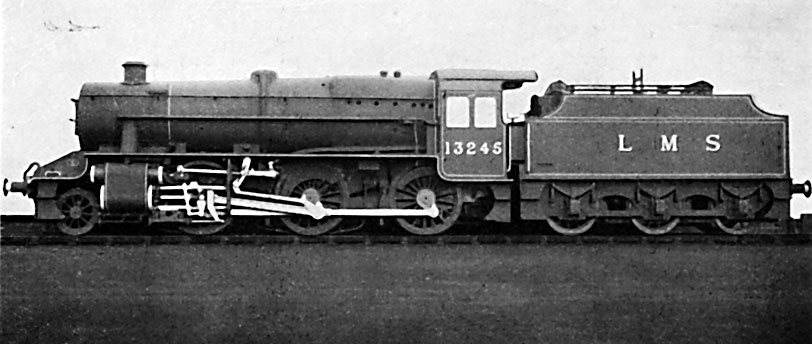
FORTY new 2-6-0 superheater two-cylinder tender engines are being built at Crewe to the designs of the Chief Mechanical Engineer. They will be numbered 13245 to 13284 inclusive, and will be of the same power as the 13000 class, their immediate predecessors, of which 245 are already giving excellent service in various parts of the L M S. There are, however, several important modifications in the new design, as the following particulars will show.
The tapered type of boiler barrel has been adopted, and the working pressure has been fixed at 225 lb. per sq. in., as against 180 lb. per sq. in. in the earlier engines.
The superheater has been proportioned to give a moderate degree of superheat, and the main regulator has been incorporated in the superheater header in the smoke-box.
A steam manifold with a main shut-off valve is provided on the top of the firebox doorplate in the cab, on which are provided the necessary valves for ejector and steam brake, injectors, carriage warming, whistle, and pressure gauge.
The feed water is supplied through top-feed valves provided on the second boiler barrel, with water-distributing trays.
Two pop-type safety valves (2½ in. diameter) are fitted in the crown of the firebox.
An exhaust steam injector with 10 mm. cones is fitted on the fireman's (right-hand) side, and on the other side is a live steam injector also with 10 mm. cones.
Other boiler mountings, such as the water gauge frames and protectors, etc., are of the Railway Company's standard type, as is also the sliding fire-door.
The two outside cylinders are 18 in. diameter by 28 in. stroke, as against 21 in. by 26 in. on the earlier engines, this reduction being rendered possible by the increased boiler pressure. Further, the use of smaller diameter cylinders has allowed these to be placed horizontally, resulting in a more compact arrangement.
The piston valves and cylinders are provided with mechanical lubrication and steam atomizer to each point of delivery, and the piston-rod packings, which are of cast iron, and valve-spindle bushes, have also mechanical lubrication. The lubricators are of L M S standard type, except in the case of the last five engines of the series, the cylinders of which will be fitted with hydrostatic lubricators for trial purposes.
The coupling and connecting rods and motion will, in accordance with the latest practice, be of high tensile manganese molybdenum steel, the connecting rods being of a fluted section. The coupling rods will, however, be rectangular,
The wheel centres are steel castings with the wheel rim of triangular section, and the tyre fixing is of the Gibson retaining-ring type. The balance weights for the coupled wheels are built up of steel plates on both sides of the spokes, and riveted, the requisite weight being provided by filling in between the plates with lead.
The axle-boxes for coupled wheels are steel castings with pressed-in brasses with suitable white-metal pockets and oil grooves provided on both sides of the crown to ensure a thorough distribution of oil to the journal. The axle box underkeep carries an efficient oil pad, which can be examined by sliding out the underkeep while the axle box is in position.
The coupled wheels each have an independent mechanical oil-feed to the crown of the axlebox, with the standard back-pressure valve and flexible oil-pipe connection.
All the coupled, truck and tender springs are of carbon steel, plain section, and with cotter fixing in the buckle on engine springs only. The spring links are of the adjustable type on engine, and solid type on tender.
The two-wheel truck is of the Bissel type, and the anchor pin is attached to a cross stretcher between the main frames, 6 ft. 7¾ in. behind the truck-wheel centre. The weight on the truck is taken through side bolsters, and the bogie side-check spring gear has been carefully arranged to ensure smooth riding.
Steam sanding is provided for the front of leading coupled wheels and front and back of driving wheels
A standard width of 8 ft. 6 in. over the cab plates is provided. The drive is on the left-hand side, and all con trois are arranged for convenient handling. Tip-up seats are fitted on each side of the cab.
Two sliding windows are provided on each side of the cab, and on the front cab-plate a hinged window provides an excellent look-out for the enginemen.
The standard carriage-warming apparatus is provided.
A steam brake, controlled by the driver's vacuum-brake valve, is fitted to the coupled wheels of the engine, and on all the six tender wheels.
A vacuum pump is fitted under the left-hand bottom slide-bar, suitably driven from the crosshead. When standing, the ejector maintains the vacuum on the engine and train.
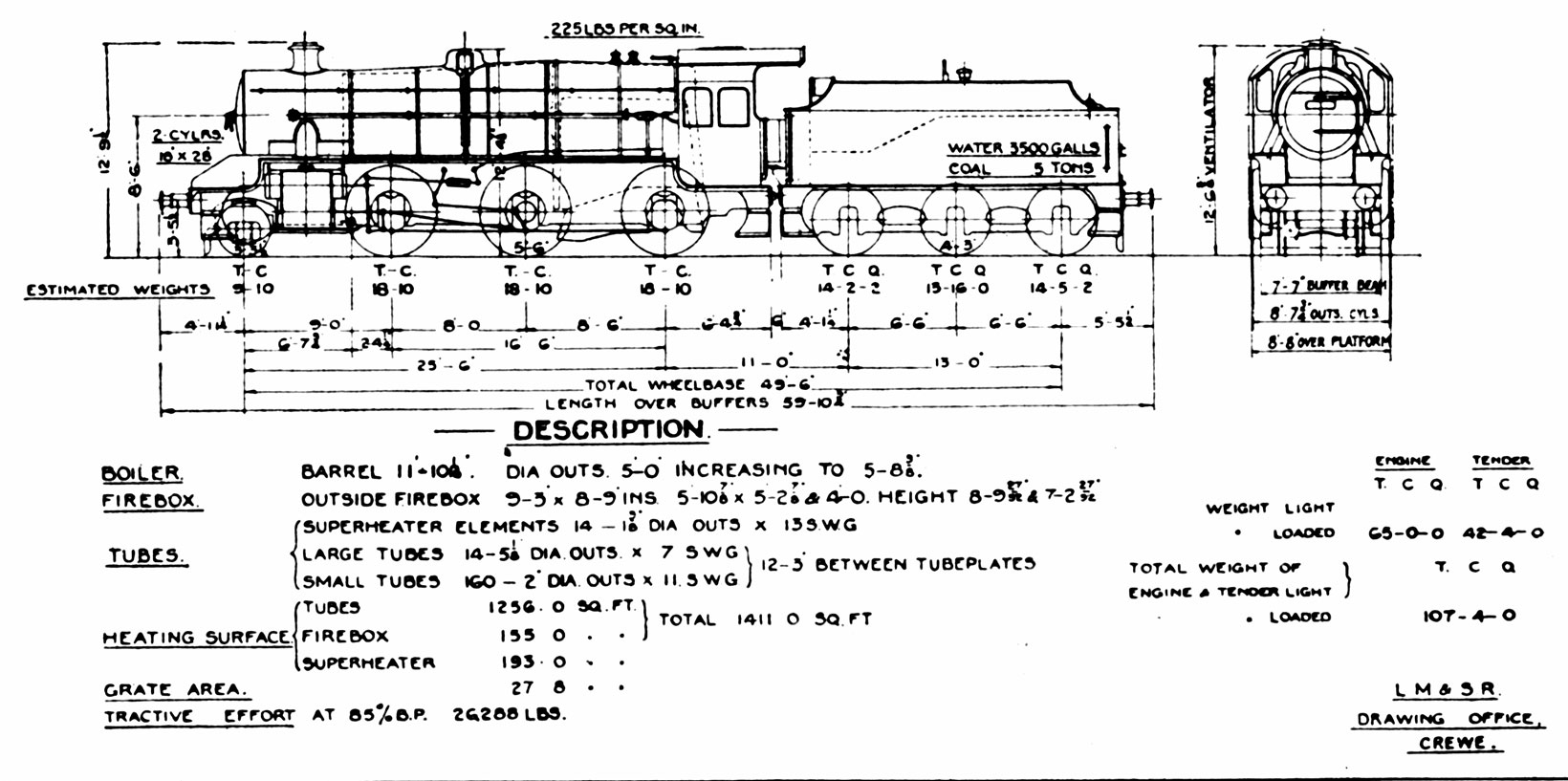
The tender is of standard type, with a capacity for 3,500 gallons of water and 5 tons of coal, and is equipped with water pick-up gear. A hand brake is fitted to the tender wheels, in addition to the steam brake referred to above.
The tractive effort is 26,288 lb.
Heating surface amounts to 1,411 sq. ft., comprising 1,256 sq. ft. tubes and 155 sq. ft. firebox, while the superheater area is 193 sq. ft., and grate area 27.8 sq. ft.
The driving wheels are 5 ft. 6 in. in diameter and the coupled wheelbase is 16 ft. 6 in., the total length of engine and tender over buffers being 59 ft. 10¾ in.
The engine in working order weighs 65 tons, and with a standard six-wheel tender having water and coal capacities of 3,500 gallons and 5 tons respectively, the total weight in working order (engine and tender) amounts to 107 tons 4 cwt., the weight on each of the three coupled axles being 18 tons 10 cwt.
These engines can be considered as a general utility type, in that, while their normal work is the haulage of fast vacuum-fitted freight trains, they can also take their turn on intermediate passenger and excursion trains.
This inter-availability enables the fullest possible use to be made of the engines and promotes economy in working.
Site contents Copyright © LMS Society, 2026
October 10th, 2026
Site contents Copyright © LMS Society, 2026