This site uses non-intrusive cookies to enable us to provide a better user experience for our visitors. No personal information is collected or stored from these cookies. The Society's policy is fully explained here. By continuing to use this site you are agreeing to the use of cookies.
[as described in the March 1939 edition of the “in-house” LMS Magazine.]
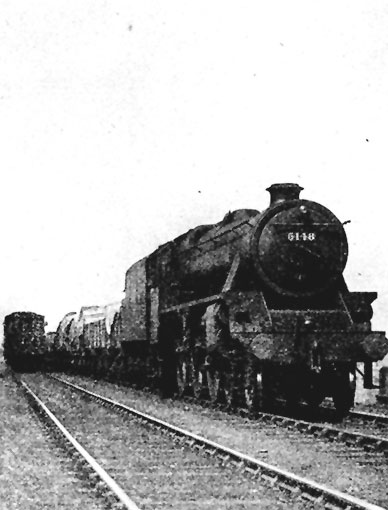
A PORTER was once asked how long the next train would be, to which he facetiously replied, "Three coaches." This arouses our curiosity as to how long trains should really be. Well, here is the answer in regard to certain classes of trains.
A loaded passenger train is limited to fifteen bogie vehicles and to a maximum weight of 500 tons, except where specially authorised by the Chief Operating Manager. Where small, other than bogie vehicles are used, the limit is twenty-two. The maximum number of milk, parcels, horse box, and passenger carriage trains is twenty-five, whilst fish trains and trains composed of horse boxes without passenger carriages may be made up to thirty. Empty coaching stock trains are restricted to a number of eight- or twelve-wheeled vehicles equal to twenty, or four or six-wheeled vehicles equal to thirty. Mixed trains are limited to thirty vehicles, as also are troop trains running at speeds not exceeding 35 miles per hour. Circus trains may convey thirty-five vehicles. Fitted freight trains Nos. 1 and 2 are limited to fifty and fifty-five respectively when not double-headed. Mineral trains must not exceed ninety, and the maximum for goods or empty wagon trains is a hundred. An officer's special without a guard must consist of one saloon only, and a motor train without guard is limited to three vehicles, which, of course, must be vacuum fitted.
Having dealt with the length of trains, we can consider another aspect, namely, the limited number of particular vehicles on certain trains. No more than ten milk tanks may be attached to a passenger train, and not more than twenty running together on a non-passenger carrying train-composed of coaching stock. A number of five vehicles containing explosives must not be exceeded on any train. Not more than two loose engine tenders can be conveyed on anyone train. Only one dead engine is allowed, except that two engines of small type, not exceeding twenty tons each, with three axles spaced 5 ft. 9 in. between centres, and not less than 5 ft. 10½ in. from outer axle to buffers are permitted.
We are also informed that certain vehicles must be marshalled in certain positions. Travelling cranes to be as near brake as possible, four-wheel milk tanks must, except where otherwise shown, be placed between six- or eight-wheeled vehicles, trains of livestock accompanied by attendants are marshalled, if possible, with fitted vehicles next to the engine. High-sided vehicles not to be placed against the brake if it is possible to avoid doing so. Two light wagons must be placed between loaded forty-ton armour plate wagons. Dead engines must be attached next to train engine, but dead engines of small type and loose engine tenders are placed on the brake. Vehicles containing explosives must be marshalled in the middle of the train, and not adjacent to vehicles containing inflammable liquids or other inflammable traffic. Wagons of livestock require placing in such positions as will admit of a minimum amount of shunting only. Any vehicle, the contents of which are liable to be set on fire, must be kept as far as possible from the engine.
Bogie rail wagons are marshalled together so far as is practicable, and a single four- or six-wheeled vehicle must not be placed between such vehicles or between these vehicles and the engine. On mixed trains, the freight vehicles are conveyed behind the passenger coaches. Gunpowder vans carried on F.F.2 trains are attached next to the fitted portion, and the screw or instanter coupling used. Unpiped vehicles with wooden centres must not be conveyed behind the rear brake in sections where intermediate block signals are provided. During the period "heating" is required vehicles not fitted with steam pipes must be marshalled in the rear of the train.
Site contents Copyright © LMS Society, 2026
January 11th, 2026
Site contents Copyright © LMS Society, 2026